
Australian Privacy Principles: 90 Days to Compliance for Businesses
Australian Privacy Principles: 90 Days to Compliance for Businesses
The Australian Privacy Principles, or APPs, are the 13 rules in Schedule 1 of the Privacy Act 1988 that govern how APP entities collect, use, store, and disclose personal information. If your organization handles personal data and earns more than AUD $3 million a year, three moves matter immediately: publish a compliant privacy policy, map where personal data actually lives, and lock in vendor data processing agreements alongside a breach response plan you have actually tested.
TL;DR:
- Most organizations over AUD $3 million in annual turnover must implement comprehensive data mapping, update privacy policies, and establish vendor agreements to meet APP requirements.
- Ensuring cross-border data transfers meet APP 8 standards requires contractual safeguards, encryption, and, preferably, storing data locally in Australia to simplify compliance.
- Privacy failures are mostly engineering issues like poor encryption, inadequate access logs, and outdated retention policies, not just legal gaps.
- Active governance, staff training, and tested breach response plans are more effective regulator targets than polished policies alone.
- Small businesses with specific activities such as health services or trading in personal data are also subject to APP compliance regardless of revenue.
Table of Contents
- Australian Privacy Principles Summary: A Quick Reference for APP 1-13
- Who Has to Comply: APP Entities and the $3 Million Threshold
- What Each Privacy Principle Actually Requires in Practice
- How to Build APP Compliance in 90 Days
- Cross-Border Data and Residency: Meeting the APP 8 Standard
- What Happens When You Get It Wrong
- The Engineering Reality Behind Privacy Compliance
- Get Your Data Infrastructure Privacy-Ready
- Sources
- FAQ
Australian Privacy Principles Summary: A Quick Reference for APP 1-13
Before diving into implementation, you need the shorthand version. Each principle below covers a distinct stage of the personal information lifecycle, from the moment you collect it to the day you delete it. The OAIC’s own quick reference tool is the authoritative source, and it’s worth bookmarking rather than memorizing.
- APP 1: Open and transparent management — Have a clear, publicly available privacy policy and manage information openly.
- APP 2: Anonymity and pseudonymity — Give people the option to interact with you anonymously or under a pseudonym where practical.
- APP 3: Collection of solicited information — Only collect personal information that’s reasonably necessary for your functions.
- APP 4: Unsolicited information — Decide within a reasonable time whether unsolicited data could have been collected under APP 3, then destroy or de-identify it if not.
- APP 5: Notification of collection — Tell people what you’re collecting, why, and who might receive it, at or before collection.
- APP 6: Use or disclosure — Only use or disclose personal information for the purpose you collected it, with defined exceptions.
- APP 7: Direct marketing — Restrict marketing use of personal information and always provide an opt-out.
- APP 8: Cross-border disclosure — Take reasonable steps to ensure overseas recipients meet APP-equivalent standards.
- APP 9: Adoption of government identifiers — Don’t adopt a government identifier (like a Medicare number) as your own customer ID.
- APP 10: Quality of information — Take reasonable steps to keep personal information accurate, complete, and current.
- APP 11: Security of information — Protect data from misuse, loss, and unauthorized access, and destroy it when no longer needed.
- APP 12: Access — Give individuals access to their own personal information on request.
- APP 13: Correction — Correct personal information when it’s shown to be inaccurate or out of date.
APPs 1, 5, 6, 8, 11, 12, and 13 are the ones most likely to force a genuine change to your policies or systems, not just your paperwork. The rest tend to be about restraint (don’t collect what you don’t need, don’t repurpose an identifier) rather than new infrastructure.
Who Has to Comply: APP Entities and the $3 Million Threshold
Most private sector organizations with annual turnover above AUD $3 million are APP entities and must comply with all 13 principles. That threshold catches most mid-sized firms, but it’s not the whole story, and treating it as a blanket exemption is one of the more common compliance mistakes small operators make.
Several categories are covered regardless of turnover:
- Private sector health service providers, including allied health and telehealth operators.
- Businesses that trade in personal information as a product, such as data brokers or list sellers.
- Contractors delivering services under a Commonwealth contract.
- Credit reporting bodies and entities handling credit-related personal information.
Run a quick self-check before assuming you’re exempt: Do you provide any health-adjacent service? Do you sell, rent, or trade contact lists or profiles? Do you hold a Commonwealth contract? A “yes” to any of those puts you inside the APP framework no matter what your revenue looks like.
What Each Privacy Principle Actually Requires in Practice
Reading the legislative text tells you the rule. It doesn’t tell you what to build. Here’s the operational translation for each APP.
APP 1 (Open management) means your privacy policy needs to be a real, current document on your website, not a static file drafted years ago. Review it whenever you add a new data collection point, like a new booking form or CRM field.
APP 2 (Anonymity) applies mostly to inquiry-stage interactions. A trades business taking a general quote request shouldn’t force a full name and address before answering a basic question.
APP 3 (Collection) is about restraint. If you’re running an online booking form and asking for a customer’s date of birth for a service that doesn’t need it, that’s a compliance gap waiting to surface in an audit.
APP 4 (Unsolicited information) shows up when someone emails you an unprompted resume or a stray customer complaint containing a third party’s details. You need a documented process for assessing and disposing of it.
APP 5 (Notification) is your collection notice: a short statement at the point of data capture explaining what you’re collecting and why. This is a high-impact APP because it touches every form, every intake call, and every signup page you run.
APP 6 (Use or disclosure) is where scope creep gets dangerous. If a customer gave you their email for appointment reminders, using that same email for a marketing newsletter without consent breaches this principle directly.
APP 7 (Direct marketing) requires an opt-out on every marketing communication, and it interacts with the Spam Act 2003 for electronic messages specifically. Check both frameworks when building marketing automation.
APP 8 (Cross-border disclosure) gets its own section below because it’s the principle most businesses get wrong when they adopt offshore software.
APP 9 (Government identifiers) rarely applies outside health and finance, but if you’re storing Medicare or tax file numbers as a customer reference key, stop immediately.
APP 10 (Quality) means building a process for customers to update their own details, rather than letting stale records accumulate for years.
APP 11 (Security) is the principle regulators scrutinize hardest. It covers encryption, access controls, and a documented retention and deletion schedule, and it interacts with health records legislation if you handle clinical data.
APP 12 (Access) requires you to respond to a personal information access request within a reasonable time, typically interpreted as 30 days.
APP 13 (Correction) obliges you to fix inaccurate records once notified, and to tell any third party you disclosed the incorrect data to.
How to Build APP Compliance in 90 Days
Compliance work fails when it starts with a policy document instead of a data audit. You can’t write an honest privacy policy if you don’t know what you’re holding, and practitioners consistently flag data mapping as the step that determines whether everything downstream actually works.
- Map your data first. Record what personal information you collect, where it’s stored, which systems touch it, who has access, and how long you keep it.
- Rewrite your privacy policy and collection notices. Align both to what the data map actually shows, satisfying APP 1 and APP 5 together rather than as separate exercises.
- Lock in vendor agreements. Every third party touching customer data needs a data processing agreement with audit rights, and any offshore vendor needs a documented cross-border risk assessment under APP 8.
- Harden security controls. Set access permissions by role, encrypt data at rest and in transit, and write a retention schedule that specifies when records get deleted or de-identified under APP 11.
- Build and test a breach response plan. Assign an owner, define notification timelines, and run at least one tabletop exercise before you need the real thing.
- Train staff and assign governance ownership. A policy nobody has read protects no one; assign a named person accountable for privacy across the business.
Pro Tip: Build your data map with fields for legal basis, sensitivity, storage location, and access owner from day one. That structure lets simple automation flag and remove stale records automatically, instead of someone manually auditing a spreadsheet every quarter.
Cross-Border Data and Residency: Meeting the APP 8 Standard
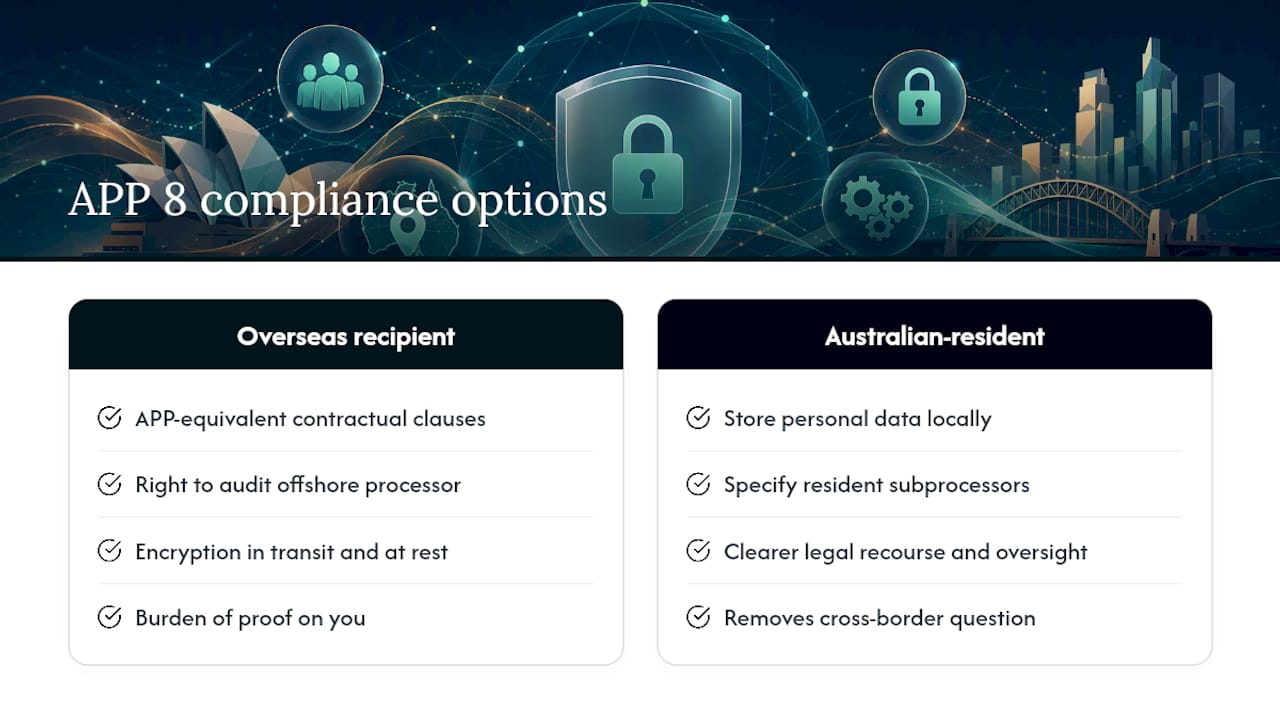
APP 8 requires you to take reasonable steps to ensure any overseas recipient of personal information handles it in a way substantially similar to the APPs themselves. “Reasonable steps” isn’t defined precisely, which means the burden of proof sits with you.
In practice, that means contractual clauses requiring APP-equivalent handling, the right to audit an offshore processor, and encryption both in transit and at rest. Where it’s feasible, specifying Australian-resident subprocessors or storing personal data on local infrastructure removes the cross-border question entirely. Data sovereignty analysis points to the same conclusion: keeping data in Australia gives you clearer legal recourse and oversight than chasing accountability through a foreign vendor’s contract terms.
What Happens When You Get It Wrong
The OAIC can investigate complaints, accept enforceable undertakings, and pursue civil penalties for serious or repeated breaches. Most enforcement action doesn’t start with a dramatic data breach. It starts with a complaint, an audit, or a follow-up on an earlier undertaking that wasn’t honored.
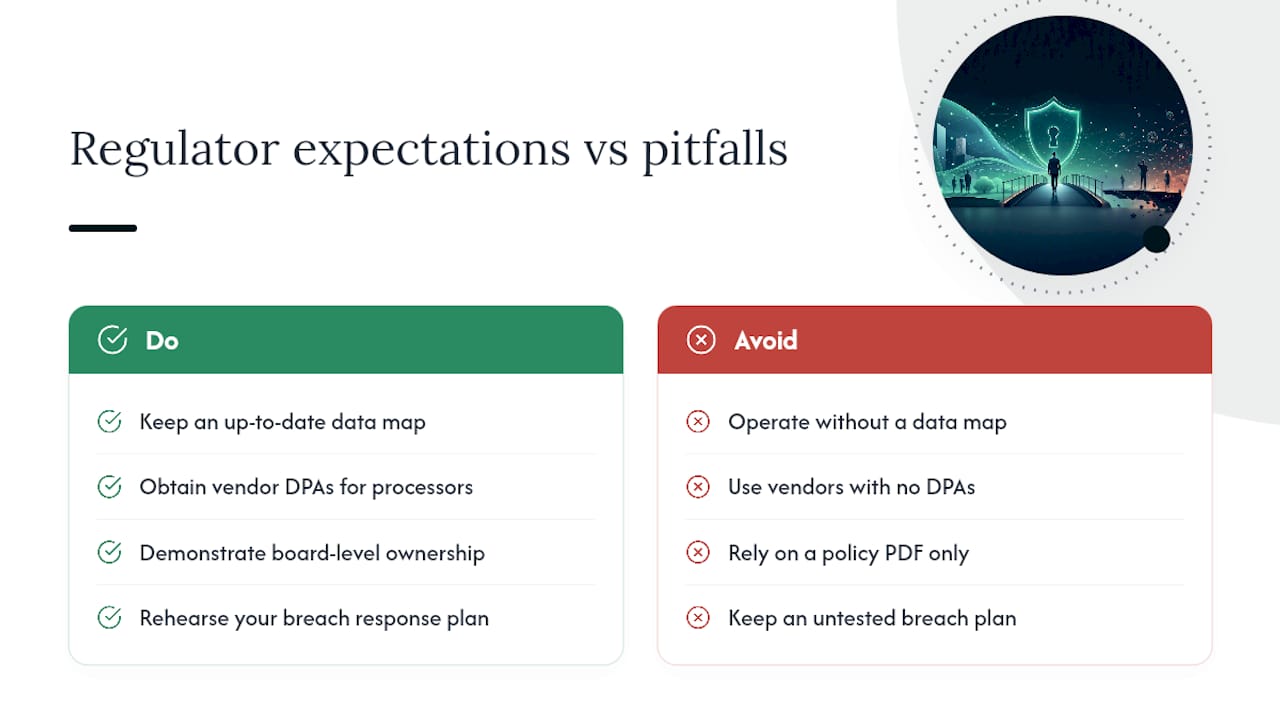
The pitfalls are consistent: no data map, no vendor DPAs, and a breach plan that exists as a document nobody has rehearsed. Regulators respond better to evidence of active governance, board-level ownership, and staff training than to a polished policy PDF with nothing behind it. Privacy by design, not privacy as an afterthought, is what the OAIC is actually looking for.
The Engineering Reality Behind Privacy Compliance
Most privacy failures aren’t legal failures. They’re engineering failures: no access logs, no encryption at rest, retention policies nobody enforces. The APPs are deliberately technology-neutral, which means the burden of proving compliance falls on your actual system design.
Any automation or MVP project should scope data residency and access controls before a single line of code gets written, not after launch. Privacy by design only works when it’s designed in.
— Lakitha
Get Your Data Infrastructure Privacy-Ready
Zatersio is the alternative to hiring a compliance consultant and a separate development shop for the same problem. We help build technical systems to support APP compliance, including data residency options, encrypted data pipelines, and engineering support to scope privacy requirements early in development.
If your data map lives in three spreadsheets and your breach plan has never been tested, workflow automation can turn that mess into a system that tracks legal basis, retention periods, and access owners automatically, flagging stale records before they become a liability. For teams needing a full-scale privacy-conscious build, MVP development projects ship in under two weeks with fixed pricing and no offshore handoffs. Book a consultation and tell us what data you’re holding. We’ll tell you what it takes to hold it safely.
Sources
- APP quick reference tool — OAIC (PDF)
- Australian Privacy Principles — ABOLIS / business.gov.au
- Privacy Act 1988 (Schedule 1) — AustLII
- Australian Privacy Principles: Summary and Key Points — Sprintlaw
FAQ
What are the 13 privacy principles in Australia about?
The 13 APPs govern how organizations collect, use, secure, disclose, and let people access their own personal information, covering the entire data lifecycle from intake to deletion.
What does APP 9 require regarding government identifiers?
APP 9 stops businesses from adopting a government identifier, such as a Medicare or tax file number, as their own way of identifying a customer, except in narrow, specified circumstances.
Are there 10 or 13 Australian privacy principles?
There are 13 Australian Privacy Principles under the Privacy Act 1988. Some other countries and older Australian frameworks used a 10-principle model, which sometimes causes confusion, but the current standard is 13.
Does my small business have to comply with the APPs?
Compliance generally applies once annual turnover exceeds AUD $3 million, but health service providers, businesses trading in personal information, and Commonwealth contractors must comply regardless of revenue.
Can Zatersio help with the technical side of privacy compliance?
Zatersio builds the data mapping systems, secure automations, and Australian-hosted infrastructure that support APP compliance, though pricing for specific builds is available on request and depends on project scope.